Workforce planning
A peak-season workforce runbook that starts in July
November's labour is decided months earlier. The planning sequence that separates operations that execute peak from operations that survive it.
1 July 2026 · 5 min read
Industries — Construction & Engineering
Construction labour demand is phase-shaped: bulk earthworks needs different crews from structures, finishes or commissioning. Sites bleed money when crews arrive late, un-ticketed or under-strength — and when demobilisation is unmanaged, labour cost outlives the phase that needed it. The industry also carries real IR volatility, which makes disciplined contracting non-negotiable.
Our read on the sector
Construction runs on programme dates and paid milestones. Labour arrives in waves that must match the programme — earthworks, structure, finishes — each with its own trades, certifications and safety file requirements, often under BCCEI or regional bargaining-council terms. A crew that's late, uncertified or unverified doesn't just cost hours; it moves handover dates that carry penalties.
We mobilise site crews with the compliance file built before boots hit site: medicals, inductions, competency certificates and council registration handled as one package. Because the work is project-shaped, engagements are project-shaped too — fixed-term crews priced per phase, scaled between milestones, and demobilised cleanly at practical completion instead of lingering on cost reports.

01
Each phase has its own trades, tickets and headcounts. The workforce plan should read like the construction programme — because it's built from it.
02
Working at heights, confined space, rigging, operating tickets and medicals must be verified before mobilisation. An un-ticketed worker on site is a stoppage waiting to be found.
03
Community labour expectations, union presence and site disputes are realities. A TES partner with IR capability keeps issues procedural instead of letting them become blockades.
General workers and trade assistants mobilised per programme phase — earthworks to finishes — with ramp-up and ramp-down agreed up front.
Medicals, inductions, PPE and certification verification completed and documented before day one on site.
Certified crews for industrial shutdowns, tie-ins and commissioning windows where every hour is programmed.
One accountable provider across sites and provinces, so labour follows the programme instead of being re-recruited per project.

Construction — in operation
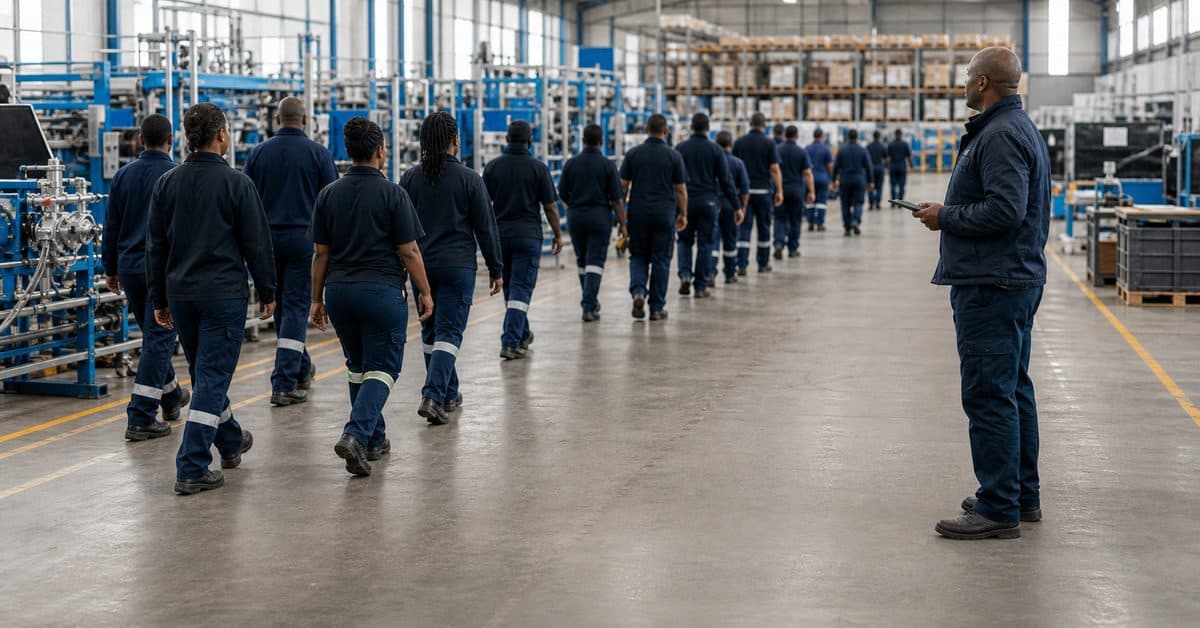
Toolbox talk before the pour — compliance practised, not claimed.
Rhythms vary by operation — the point is that we plan against yours, not against a generic calendar.
Site establishment
Crew scoping against the programme, compliance files built, inductions and medicals completed.
Structure & wet works
Peak headcount: attendance at the gate, daily replacement discipline, rain-day and stoppage protocols agreed.
Finishes & tie-ins
Trade-assistant crews rotate in as trades change; certified teams for tie-ins and commissioning.
Handover & demob
Clean demobilisation at practical completion — documentation closed out, no lingering labour cost.
Compliance in this sector
Crews are contracted per phase with verified certifications and medicals, aligned to applicable council terms and site-specific safety files. Demobilisation is planned with full statutory close-out.
Compliance & IR supportYes. RiseUp runs industrial operations from Secunda alongside Durban, Johannesburg and Cape Town, and plans mobilisation logistics — transport, accommodation coordination, inductions — as part of the crewing plan.
Under Project and Managed models, RiseUp's supervision and IR structures handle worker discipline and disputes procedurally, coordinated with your site management.
Demobilisation is in the plan from day one: fixed-term contracts end lawfully, close-out documentation is completed, and crews for the next phase are scheduled before the current one winds down.

Workforce planning
November's labour is decided months earlier. The planning sequence that separates operations that execute peak from operations that survive it.
1 July 2026 · 5 min read

Workforce planning
Vacancy maths looks harmless on a spreadsheet. On a line-balanced operation it compounds — here's how to price a labour gap properly before you decide what cover is worth.
15 June 2026 · 6 min read

Compliance
Deemed employment is the clause everyone cites and few read. What the three-month rule actually changes, and how a properly structured TES engagement lives with it.
20 May 2026 · 7 min read
One conversation to scope roles, sites, volumes and timelines — followed by a written plan with the model, the mechanics and the numbers.